
Pilonidal Sinus Treatment in Pune
Permanent Solution Through Individualised Care & S.M.A.R.T. Ksharsutra™ Protocol
A pilonidal sinus is more than a small opening near the tailbone. It is a chronic condition in which hair, skin debris and bacteria become trapped beneath the skin, leading to repeated infection, pain and pus discharge. Many patients experience temporary relief with medicines or repeated abscess drainage, only to find that the problem returns after weeks or months.
Although pilonidal sinus is commonly seen in young adults, especially those who sit for prolonged periods or have dense body hair, every patient’s condition is different. Some develop a single sinus opening, while others have multiple tracts, recurrent abscesses or repeated infections after previous surgery.
At Om Ayurvedic Clinic, treatment begins with understanding the extent of the disease rather than simply treating the visible opening. Careful evaluation allows us to recommend an individualised treatment plan based on the patient’s condition, lifestyle and long-term recovery goals.
Many Patients Mistake It for a Boil or Pimple
A pilonidal sinus often begins as a small swelling or pimple near the tailbone. Because the symptoms may temporarily improve after the abscess drains, many people delay treatment until repeated infections occur. Early evaluation can help prevent recurrent abscess formation and further progression of the disease.
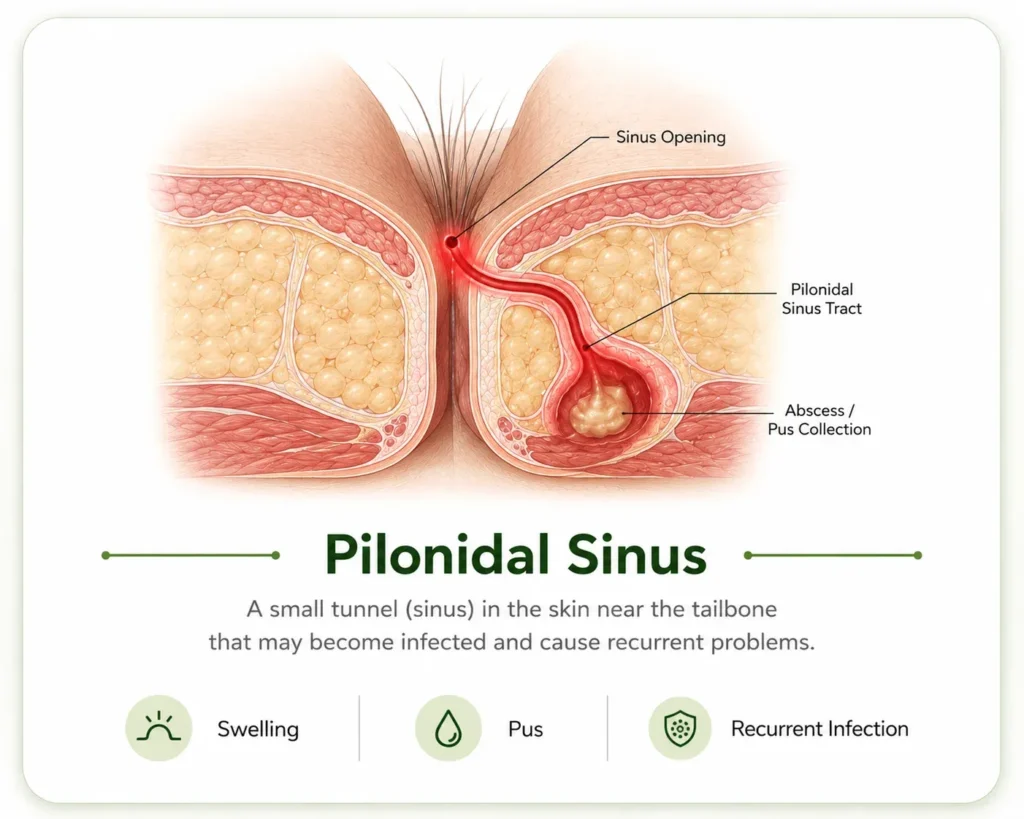
Symptoms of Pilonidal Sinus
The symptoms of a pilonidal sinus can vary depending on whether the condition is in its early stage or has become infected. Some patients notice only a small dimple or tiny opening near the tailbone, while others develop pain, swelling and repeated pus discharge due to recurrent infection.
In the early stages, symptoms may come and go, leading many people to ignore the problem. However, as infection progresses, everyday activities such as sitting, driving or prolonged standing may become increasingly uncomfortable. Recognising these symptoms early allows timely evaluation and helps prevent repeated abscess formation and chronic disease.
Common Symptoms
Patients with a pilonidal sinus may experience one or more of the following symptoms:
✔ Pain or tenderness near the tailbone
✔ Swelling in the cleft between the buttocks
✔ Pus or blood-stained discharge
✔ Recurrent boils or abscesses
✔ Foul-smelling discharge
✔ Small pits or openings in the skin
✔ Difficulty sitting comfortably
✔ Redness and warmth around the affected area
Early Symptoms
In the beginning, a pilonidal sinus may cause only mild discomfort.
Common early signs include:
- A small dimple near the tailbone
- Occasional discomfort while sitting
- Mild swelling
- Slight clear or yellow discharge
- Intermittent itching around the natal cleft
Because these symptoms are often mild, many patients postpone treatment until infection develops.
Symptoms of an Infected Pilonidal Sinus
When infection occurs, symptoms usually become more noticeable.
These may include:
- Severe pain while sitting or walking
- Rapidly increasing swelling
- Pus discharge
- Fever (occasionally)
- A painful abscess near the tailbone
- Difficulty performing routine activities
An infected pilonidal sinus should be assessed promptly to avoid further complications.
Do Not Ignore Repeated Swelling Near the Tailbone
A swelling that repeatedly appears, drains and then returns is unlikely to be a simple boil. Recurrent pain or discharge near the tailbone should be evaluated by a doctor to determine whether a pilonidal sinus is present.
Not Every Patient Experiences All Symptoms
Some patients have only a tiny opening with occasional discharge, while others develop repeated infections and abscesses. The severity of symptoms does not always indicate the complexity of the disease, making proper clinical evaluation important.
Causes of Pilonidal Sinus
A pilonidal sinus develops due to hair inside the skin in the cleft between the buttocks, triggering inflammation and infection. Over time, the body treats the hair as a foreign object, resulting in the formation of a sinus tract beneath the skin. This tract may become repeatedly infected, leading to pain, swelling and pus discharge.
Although the exact cause varies from person to person, pilonidal sinus usually develops due to a combination of hair penetration, friction, prolonged pressure and individual susceptibility, rather than a single factor. Understanding these risk factors helps patients recognise why the condition may recur if the underlying causes are not addressed.
Hair Follicle Blockage and Chronic Inflammation
The exact mechanism by which a pilonidal sinus develops is still being studied. The most widely accepted theory suggests that loose hair becomes embedded within the skin and acts as a foreign body, triggering inflammation and infection.
Based on our clinical observations, however, pilonidal sinus may also develop when a hair follicle becomes blocked, preventing the normal hair from emerging through the skin. The trapped hair continues to grow beneath the skin, where it behaves like a foreign body. This may trigger chronic inflammation, involve adjacent hair follicles and eventually lead to abscess formation and the development of a sinus tract.
Regardless of the exact mechanism, the result is the same—a chronic inflammatory condition that usually requires appropriate treatment to achieve healing and reduce the risk of recurrence.
Prolonged Sitting and Friction
People who spend long hours sitting—such as office workers, drivers and students—may experience increased pressure and friction over the tailbone. This repeated mechanical stress can contribute to the development of a pilonidal sinus.
Excess Body Hair
Individuals with coarse or dense body hair are generally at a higher risk because loose hairs can more easily collect within the natal cleft and penetrate the skin.
Deep Natal Cleft
A naturally deep cleft between the buttocks can create a warm, moist environment where hair and debris accumulate more easily, increasing the likelihood of recurrent irritation and infection.
Obesity and Lifestyle Factors
Excess body weight, prolonged sweating, inadequate ventilation of the area and repeated local irritation may further increase the risk of developing or aggravating a pilonidal sinus.
Understanding Pilonidal Sinus in Ayurveda – Nadi Vrana
In Ayurveda, pilonidal sinus is understood in the context of Nadi Vrana — a chronic, tract-forming wound that discharges repeatedly and resists healing until the underlying passage is properly addressed. Classical Ayurvedic surgical texts describe such conditions as requiring more than surface-level treatment: the sinus tract itself, not just the visible opening, must be managed for lasting healing. This principle — treating the complete tract rather than only the symptom — is the foundation of how the S.M.A.R.T. Ksharsutra Protocol™ approaches pilonidal sinus today.
Can Pilonidal Sinus Be Prevented?
Although not every case can be prevented, the risk may be reduced by:
✓ Maintaining good local hygiene
✓ Keeping the area clean and dry
✓ Avoiding prolonged uninterrupted sitting
✓ Managing excess body hair when appropriate
✓ Maintaining a healthy body weight
These measures are particularly important after treatment to reduce the likelihood of recurrence.
Formation of Pilonidal Sinus- Animated video

Diagnosis of Pilonidal Sinus
A pilonidal sinus can often be diagnosed through a careful medical history and clinical examination. Unlike many other conditions, extensive investigations are usually not required because the disease is located just beneath the skin and can often be identified by its characteristic appearance.
The purpose of diagnosis is not only to confirm the presence of a pilonidal sinus but also to determine its extent, identify any active infection or abscess, detect multiple sinus openings and plan the most appropriate treatment. An accurate assessment helps avoid incomplete treatment and reduces the risk of recurrence.
Medical History
Your consultation begins with understanding the history of your symptoms.
The doctor will ask about:
- Pain near the tailbone
- Swelling or recurrent abscesses
- Pus or blood-stained discharge
- Previous treatment or surgery
- Duration of symptoms
- Frequency of recurrence
- Difficulty while sitting or driving
A detailed history often provides valuable information about the progression of the disease.
Clinical Examination
A gentle examination of the natal cleft is usually sufficient to diagnose a pilonidal sinus.
The examination helps identify:
✔ Sinus openings (pits)
✔ Number of sinus tracts
✔ Presence of active infection
✔ Swelling or abscess
✔ Hair trapped within the sinus
✔ Extent of local inflammation
This examination is generally performed in the outpatient department and usually takes only a few minutes.
Are Investigations Required?
Most patients do not require routine investigations for diagnosis.
However, imaging studies such as ultrasound or MRI may occasionally be advised when:
- The disease is recurrent.
- Multiple sinus tracts are suspected.
- The diagnosis is uncertain.
- Extensive disease is present.
Investigations are recommended only when they are likely to influence treatment planning.
Early Diagnosis Makes Treatment Easier
Many patients wait until repeated abscesses develop before seeking treatment. Early evaluation allows treatment to be planned before the disease becomes more extensive, helping reduce discomfort and the risk of recurrent infection.
Treatment Options for Pilonidal Sinus
Choosing the Right Treatment for Pilonidal Sinus
The appropriate treatment for pilonidal sinus depends on several factors, including the size and complexity of the sinus, the presence of infection or abscess, previous treatment history, and the patient’s overall health.
Today, several treatment approaches are available. The most suitable option should always be decided after a detailed clinical examination and discussion with an experienced treating doctor.
Modern Surgical Treatment Options
Depending on the patient’s condition, colorectal surgeons may recommend one of several surgical procedures, including:
- Incision and drainage for an acute abscess
- Excision with open wound healing
- Excision with primary closure
- Flap procedures (such as Limberg or Karydakis flap)
- Minimally invasive procedures such as EPSiT in selected cases
Each technique has its own advantages, limitations, healing period, postoperative care requirements, and suitability for different patients.
👉 At Om Ayurvedic Clinic, we do not perform these surgical procedures. They are mentioned here only to help patients understand the currently available treatment options.
Why Medicines Alone Are Usually Not Enough
Antibiotics and pain-relieving medicines may temporarily reduce infection and discomfort, but they generally do not remove the underlying sinus tract. As long as the tract remains beneath the skin, the condition may recur after the medicines are stopped.
Therefore, the aim of definitive treatment is to address the underlying sinus rather than only controlling the symptoms.
👉 The goal of treatment is not only to relieve pain or discharge but also to treat the underlying disease, promote healthy healing, and help patients return to their normal daily activities with confidence.
What Makes the S.M.A.R.T. Ksharsutra Protocol™ Different for Pilonidal Sinus?
The ideal treatment for pilonidal sinus should not only eliminate the disease but also help patients recover comfortably and return to their normal routine with confidence.
The S.M.A.R.T. Ksharsutra Protocol™ is an evidence-based, clinically refined evolution of the traditional Ayurvedic Ksharsutra technique, developed through more than 27 years of continuous clinical experience. Every patient receives an individualized treatment plan based on the extent of the disease, previous treatment history, and overall health.
For appropriately selected patients, the protocol focuses on healthy healing while minimizing unnecessary postoperative restrictions.
Why Patients Choose the S.M.A.R.T. Ksharsutra Protocol™
✔ Evidence-Based Evolution of Ksharsutra Technique
✔ Herbal Medicated Therapy
✔ No Large Surgical Wound
✔ Usually No Prolonged Daily Wound Dressings
✔ Routine Hair Removal Generally Not Required
✔ Routine Post-Treatment Antibiotics Generally Not Required*
✔ Early Return to Routine Activities Whenever Clinically Appropriate
✔ Individualized Treatment Planning
✔ Structured Follow-up Until Complete Healing
✔ Approximately 95% clinical success in appropriately selected patients**
✔ Published Clinical Research and International Patient Experience
* Antibiotics may be prescribed when clinically indicated.
** Based on our clinical experience in appropriately selected patients completing the recommended treatment and follow-up.
Watch how the S.M.A.R.T. Ksharsutra Protocol™ works for Pilonidal Sinus
Recovery After Pilonidal Sinus Treatment
What to Expect During Recovery
Recovery after pilonidal sinus treatment varies from one patient to another. The healing period depends on several factors, including the extent of the disease, the type of treatment performed, previous infections or surgeries, the patient’s general health, and how well the post-treatment instructions are followed.
Most patients are eager to know when they can return to work, sit comfortably, travel, or resume their normal daily activities. Although the exact recovery period differs for each individual, proper wound care and regular follow-up play a vital role in achieving good healing.
Factors That Influence Recovery
The speed of recovery depends on several important factors:
- The size and depth of the sinus tract
- Whether the disease is primary or recurrent
- Presence of active infection or abscess
- General health and immune status
- Personal hygiene and wound care
- Regular follow-up as advised by the treating doctor
Patients who actively participate in their treatment and follow medical advice generally experience smoother recovery.
Tips for a Better Recovery
Simple lifestyle measures can help promote healing and reduce the chance of recurrence:
- Keep the treatment area clean and dry.
- Maintain good personal hygiene.
- Avoid prolonged pressure on the affected area whenever possible.
- Follow wound care instructions carefully.
- Attend scheduled follow-up visits.
- Inform your doctor promptly if you notice increasing pain, swelling, fever, or excessive discharge.
These measures support healing irrespective of the treatment method used.
Returning to Normal Activities
Many patients can gradually return to their routine activities during the recovery period, depending on their occupation, daily physical activity, and individual healing progress.
Your treating doctor will advise you regarding:
- Sitting comfortably
- Walking and light exercise
- Returning to office work
- Driving
- Travelling
- Resuming strenuous physical activity
Following these recommendations helps ensure a safe and comfortable recovery.
Long-Term Care to Reduce Recurrence
Even after complete healing, maintaining good hygiene, avoiding prolonged accumulation of loose hair in the natal cleft, and attending follow-up when advised can help reduce the likelihood of future problems.
At Om Ayurvedic Clinic, patient care does not end after treatment. Regular follow-up, patient education, and long-term guidance are an integral part of the S.M.A.R.T. Ksharsutra Protocol, helping patients achieve sustained recovery and confidently return to their normal lives.
Research & Publications
Advancing Evidence-Based Care Through Clinical Research
At Om Ayurvedic Clinic, clinical practice and research go hand in hand. Every complex case provides an opportunity to improve our understanding of anorectal diseases and refine the S.M.A.R.T. Ksharsutra Protocol™. Carefully documenting treatment outcomes and publishing unusual or challenging cases helps strengthen the scientific evidence supporting Ayurvedic management of pilonidal sinus and related disorders.
Our objective is not simply to treat patients, but also to contribute responsibly to medical knowledge through peer-reviewed publications and continuous clinical observation.
Published Clinical Experience
One of our most significant published case reports describes an exceptionally rare condition in which a pilonidal sinus extended to form a complex trans-sphincteric anal fistula. The patient was successfully managed using the S.M.A.R.T. Ksharsutra Protocol™ without routine postoperative antibiotics. This work was published in the Indian Journal of Colo-Rectal Surgery and reflects our commitment to documenting challenging clinical scenarios.
Our research has also been published in national and international colorectal surgery journals covering complex anal fistula, pilonidal sinus, and other challenging anorectal conditions, contributing to the growing body of evidence supporting carefully planned Ksharsutra treatment.
Research That Improves Patient Care
Over more than 27 years of continuous clinical practice, our focus has been on refining every stage of treatment—from disease assessment and individualized planning to structured follow-up and long-term outcomes.
This ongoing work has contributed to:
- Continuous refinement of the S.M.A.R.T. Ksharsutra Protocol™
- Better understanding of complex and recurrent anorectal diseases
- Scientific publication of unusual and challenging clinical cases
- Development of patient-centred treatment protocols based on clinical observation
- Ongoing innovation, including applications for intellectual property related to treatment methods and devices
Commitment to Scientific Excellence
We believe that every published case represents more than an academic achievement—it represents a patient whose treatment has contributed to improving future healthcare.
Our commitment is to continue combining classical Ayurvedic wisdom, evidence-based clinical practice, and scientific documentation to provide responsible, transparent, and continually improving patient care.
Real Patient Experiences - Reviews
Hear from Patients Who Chose Om Ayurvedic Clinic
Choosing treatment for pilonidal sinus is often a difficult decision. Many of our patients come to us after struggling with recurrent infections, repeated abscesses, previous surgeries, or the fear of another recurrence.
Their experiences reflect not only the treatment they received but also the confidence they regained during their recovery journey.
Every patient’s condition is unique, and treatment outcomes vary depending on the severity of the disease, previous treatment history, and individual health. However, reading genuine patient experiences can help others understand what to expect and make informed decisions about their own care.
Frequently Asked Questions About Pilonidal Sinus Treatment
1. Can a pilonidal sinus heal without surgery?
A pilonidal sinus rarely heals permanently with medicines alone because the sinus tract usually remains beneath the skin. Temporary improvement may occur, but symptoms often recur if the underlying disease is not treated appropriately.
2. Is the S.M.A.R.T. Ksharsutra Protocol™ painful?
Most patients tolerate the treatment well. Mild discomfort may occur during the initial phase, but it is generally manageable. Every patient’s experience is different, and your doctor will explain what to expect before starting treatment.
3. How long does pilonidal sinus treatment take?
The duration of treatment depends on the size / length of the sinus, previous surgeries, the presence of infection, and individual healing. During your consultation, Dr. Prasad Bapat will estimate the expected treatment duration based on your specific condition.
4. Can pilonidal sinus come back after treatment?
Recurrence is possible with any treatment method. However, careful disease assessment, individualized treatment planning, proper follow-up, and adherence to post-treatment advice help reduce the chances of recurrence.
5. Will I need prolonged bed rest after treatment?
In most cases, prolonged bed rest is not required. Patients are encouraged to continue routine activities according to their comfort level and the advice of the treating doctor. Recovery recommendations vary depending on the individual case.
6. Will I need regular hair removal after treatment?
Routine lifelong hair removal is not generally recommended as part of the S.M.A.R.T. Ksharsutra Protocol™. Your doctor will advise you regarding personal hygiene and any specific precautions based on your individual condition.
7. Do I need antibiotics after treatment?
Antibiotics are not required after treatment. They are prescribed only when clinically indicated, such as in the presence of active infection or other medical necessity.
8. Can I send my reports online before visiting?
Yes. Patients from other cities and countries can send their previous medical records, photographs (when appropriate), and investigation reports through WhatsApp or email for an initial review. A detailed treatment plan is provided only after a proper clinical assessment.
Still Have Questions?
We’ve answered the most common questions above, but many patients have additional concerns about work, travel, exercise, diet, wound care, recurrence, and long-term recovery.