
Anal Fistula (Fistula in Ano) Treatment in Pune
Expert evaluation and personalised treatment for simple and complex anal fistulas using evidence-based Ayurvedic care and the –
S.M.A.R.T. Ksharsutra™ Protocol.
An anal fistula (fistula in ano) is an abnormal tunnel that develops between the anal canal and the skin around the anus, most commonly after an infection in the anal glands. It may cause persistent pus discharge, pain, swelling and repeated abscess formation. While some fistulas appear simple, others can be complex and may recur if the underlying tract is not completely treated.
Choosing the right treatment is important because every fistula is different. The location, length, branching pattern and involvement of the anal sphincter muscles all influence the treatment approach. At Om Ayurvedic Clinic, every patient undergoes careful clinical evaluation before an individualised treatment plan is recommended. Our goal is not only to control infection and promote healing but also to preserve normal bowel function and minimise the risk of recurrence through the S.M.A.R.T. Ksharsutra™ Protocol when appropriate.
Whether you have recently been diagnosed or are seeking treatment after previous surgery, this guide will help you understand anal fistula, available treatment options and what to expect during recovery.
Symptoms & Signs of Anal Fistula
The symptoms and signs of an anal fistula vary depending on the location, size and complexity of the fistula tract. Some patients experience persistent pus discharge with very little pain, while others develop repeated abscesses, swelling or severe discomfort around the anus. Because many of these symptoms resemble other anorectal conditions such as piles or anal fissure, a proper clinical examination is important for an accurate diagnosis.
Recognizing these symptoms early and seeking timely medical advice can help prevent recurrent infections and avoid unnecessary complications.
Persistent Pus Discharge
The most common symptom of an anal fistula is continuous or intermittent pus discharge from a small opening near the anus. The discharge may stain undergarments, produce an unpleasant odour and temporarily decrease after the tract drains.
Pain Around the Anus
Pain is usually more noticeable while sitting, walking or during bowel movements. It often becomes severe when an abscess develops and may improve temporarily after pus drains.
Recurrent Swelling or Abscess
Repeated painful swelling near the anus is often a sign of an underlying fistula. Although an abscess may burst or be drained, the infection frequently returns if the fistula tract remains untreated.
Bleeding or Irritation
Some patients notice slight bleeding, skin irritation or persistent moisture around the anal region because of ongoing discharge and inflammation.
Recurrent Infection
Anal fistulas rarely heal permanently without appropriate treatment. Infection may repeatedly flare up, leading to cycles of swelling, drainage and temporary relief.
External Opening Near the Anus
Many fistulas develop a small visible opening on the skin near the anus through which pus or fluid may drain. However, not every external opening indicates the complexity of the fistula, making proper clinical examination essential.
Not every patient experiences all of these symptoms. Some fistulas produce only occasional discharge with little pain, while others present as repeated abscesses without an obvious external opening. A clinical examination is the most reliable way to confirm the diagnosis and determine the appropriate treatment.
Causes of Anal Fistula
An anal fistula usually develops as a result of an infection in the small glands located inside the anal canal. When one of these glands becomes blocked, bacteria can multiply and form an anal abscess. If the infection is not completely resolved, it may create an abnormal tunnel between the anal canal and the skin around the anus. This tunnel is known as an anal fistula (fistula in ano).
Although most fistulas associated with perianal abscess, certain medical conditions and previous surgeries may also increase the risk. Identifying the underlying cause helps in selecting the most appropriate treatment and reducing the chances of recurrence.
Anal Abscess (Most Common Cause)
Nearly 90% of anal fistulas develop after an infection of the anal glands. An untreated or partially healed abscess may leave behind a persistent fistula tract, resulting in recurrent discharge or repeated infections.
Crohn's Disease
Crohn’s disease is an inflammatory bowel disorder that can increase the risk of developing multiple or complex anal fistulas. Patients with Crohn’s disease often require coordinated management of both the bowel disease and the fistula.
Previous Anal Surgery or Trauma
Occasionally, previous anorectal surgery, injury or trauma to the anal region may contribute to fistula formation during the healing process.
Tuberculosis and Other Infections
Although less common today, tuberculosis and certain chronic infections can lead to anal fistula formation. These conditions require appropriate medical evaluation before treatment planning.
Rare Causes
Rarely, anal fistulas may be associated with conditions such as malignancy, congenital abnormalities or chronic inflammatory disorders. These are uncommon but should always be considered in recurrent or atypical cases.
Important to Know
An anal fistula is not caused by eating spicy food, lifting heavy weights or poor hygiene. While these factors may aggravate symptoms in some patients, they are not the primary cause of fistula formation. The underlying problem is usually an infection that leads to the development of a fistula tract.
Diagnosis of Anal Fistula
The success of anal fistula treatment depends on an accurate diagnosis. No two fistulas are exactly alike. Some are simple, while others have multiple branches, involve the anal sphincter muscles or recur after previous treatment. Choosing the most appropriate treatment therefore begins with understanding the exact anatomy of the fistula tract rather than simply treating the external opening.
At Om Ayurvedic Clinic, every patient undergoes a systematic clinical evaluation before a treatment plan is recommended. The objective is to identify the fistula tract, assess its complexity, preserve normal sphincter function and minimise the risk of recurrence.
Detailed Medical History
The consultation begins with understanding your symptoms and previous medical history.
We discuss:
- Duration of symptoms
- Previous anal abscess
- Earlier surgeries
- Pus discharge
- Pain and swelling
- Recurrence after previous treatment
- Associated medical conditions such as Crohn’s disease
A detailed history often provides important clues about the nature and complexity of the fistula.
Detailed Medical History
Careful local examination remains the most important step in diagnosing an anal fistula.
The examination helps identify:
- External opening
- Location of the fistula tract
- Active infection
- Presence of swelling or abscess
- Number of external openings
- Possible internal opening
Most patients can be examined comfortably in the outpatient department.
MRI Fistulogram and Other Investigations
In selected patients, additional investigations such as MRI Fistulogram, USG or X-ray may be recommended, especially when the fistula is complex, recurrent or has multiple branches.
MRI helps assess:
- Course of the fistula tract
- Secondary branches
- Deep extensions
- Relationship with sphincter muscles
However, not every patient requires an MRI. The decision depends on individual clinical findings.
Why Accurate Diagnosis Matters
Treating only the external opening without identifying the complete fistula tract may increase the risk of persistent infection or recurrence.
A proper diagnosis helps determine:
✓ Whether the fistula is simple or complex.
✓ The most suitable treatment approach.
✓ The expected recovery process.
✓ The likelihood of preserving normal bowel control.
Individualised Treatment Begins with Individualised Diagnosis
Every anal fistula is different. At Om Ayurvedic Clinic, treatment recommendations are based on careful evaluation rather than a one-size-fits-all approach.
Formation of Anal Fistula - Animated Video

Types of Anal Fistula
Not all anal fistulas are the same. Some are short and straightforward, while others may have multiple branches, extend deeper into the surrounding tissues or involve the anal sphincter muscles. Understanding the type and complexity of an anal fistula is important because it directly influences the choice of treatment, healing time and the risk of recurrence.
Doctors classify anal fistulas according to the path of the fistula tract in relation to the anal sphincter muscles. Although these medical terms may sound complicated, the main purpose of classification is to help plan the safest and most effective treatment while preserving normal bowel control.
With reference to depth –
Low anal (75%), High anal (8%), Subcutaneous(5%), Anorectal (7%), Sub mucous (5%)
With reference to depth –
Intersphincteric (64%), Trans sphincteric (30%), Subcutaneous(5%). Submucosal (5%), Extra sphincteric (1%)
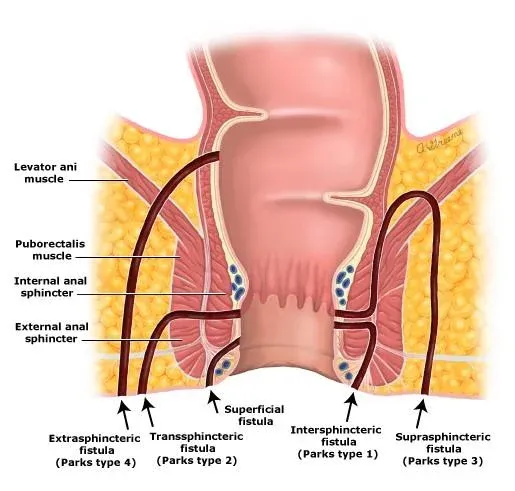
Intersphincteric Fistula
This is the most common type of anal fistula. The fistula tract lies between the internal and external anal sphincter muscles before opening onto the skin around the anus. It is generally less complex than other types and is often associated with a favourable treatment outcome when appropriately managed.
Transsphincteric Fistula
In this type, the fistula tract passes through both sphincter muscles before reaching the skin. Depending on how much of the sphincter is involved, treatment planning becomes more important to achieve healing while protecting continence.
Suprasphincteric Fistula
A suprasphincteric fistula travels upward above the external sphincter before descending to the skin. Although less common, it is generally more complex and requires careful evaluation before treatment.
Extrasphincteric Fistula
This is an uncommon type of fistula. The tract passes outside the sphincter muscles and is often associated with conditions such as previous surgery, trauma or inflammatory diseases. Detailed investigation is usually recommended before deciding on treatment.
Understanding Anal Fistula in Ayurveda – Bhagandara
In classical Ayurvedic texts, anal fistula is described as Bhagandara — one of the Ashta Mahagada (eight major diseases) considered deep-rooted and prone to recurrence if not managed correctly. The term combines “Bhaga” (the perineal region) and “Darana” (tearing), reflecting how the condition develops: a tract forms between the anal canal and the surrounding skin, usually following an unhealed abscess. Ancient Ayurvedic surgery, described extensively in the Sushruta Samhita, recognised the importance of addressing the complete tract rather than only the visible opening — a principle that continues to guide evidence-based Ksharsutra treatment today.
Treatment Options for Anal Fistula
The most appropriate treatment for an anal fistula depends on several factors, including the location of the fistula tract, its complexity, involvement of the anal sphincter muscles, previous surgeries and the patient’s overall health. There is no single treatment that is suitable for every patient.
The primary goals of anal fistula treatment are to eliminate infection, help body to create healthy tissue for complete healing, preserve normal bowel control and reduce the risk of recurrence. After careful clinical evaluation, your doctor will recommend the treatment approach that is most appropriate for your individual condition.
Conservative (Non-Surgical) Treatment
Small infections may occasionally respond to antibiotics and supportive care, but a true anal fistula rarely heals permanently with medicines alone. Medication may temporarily reduce infection or discomfort but does not usually eliminate the fistula tract.
Conventional Surgical Treatment
Depending on the type and complexity of the fistula, colorectal surgeons may recommend one of several surgical procedures, including:
- Fistulotomy (laying open the fistula tract)
- Fistulectomy (surgical excision of the tract)
- Seton Placement ( for complex or high fistulas )
- Advancement Flap (in selected cases)
- LIFT Procedure (Ligation of Intersphincteric Fistula Tract)
- VAAFT
- Laser Treatment (FiLaC)
Each of these techniques has its own indications, healing period, and postoperative care requirements. Also each technique has its own indications, advantages and limitations. So the choice depends on and the right choice depends on individual clinical assessment.
👉 At Om Ayurvedic Clinic, we do not perform these surgical procedures. They are mentioned here only to help patients understand the currently available treatment options
Ayurvedic "S.M.A.R.T. Ksharsutra™
Successful treatment of anal fistula requires more than simply closing the external opening. The primary objective is to eliminate the fistula tract while preserving healthy tissue and maintaining normal anal sphincter function whenever clinically appropriate.
The S.M.A.R.T. Ksharsutra Protocol™ is an evidence-based, clinically refined evolution of the traditional Ayurvedic Ksharsutra technique. Developed through more than 27 years of clinical experience, it combines careful disease assessment, individualized treatment planning, standardized treatment, and structured follow-up.
For appropriately selected patients, the protocol is designed to provide effective disease management while minimizing disruption to daily life.
Success Rate & Recurrence
Based on our clinical experience, the S.M.A.R.T. Ksharsutra Protocol™ has achieved approximately <strong>95% clinical success in appropriately selected patients</strong> completing the recommended treatment and follow-up. Recurrence risk depends on the complexity of the fistula tract, prior treatment history, and adherence to follow-up care — factors that are assessed individually for every patient during consultation.
How Is the Right Treatment Selected?
Choosing the most appropriate treatment depends on:
✔ Type of anal fistula
✔ Complexity of the fistula tract
✔ Involvement of sphincter muscles
✔ Previous surgeries
✔ Associated diseases such as Crohn’s disease
✔ General health of the patient
No treatment should be selected without a proper clinical examination.
There Is No Universal “Best Treatment”
Patients often ask,
“Which treatment is the best for an anal fistula?”
The answer depends on the type, location and complexity of the fistula. The best treatment is the one that is most appropriate for your specific condition, based on a careful diagnosis and an individualised treatment plan.
Recovery After Anal Fistula Treatment
Recovery after anal fistula treatment is influenced by several factors, including the type of fistula, its complexity, the treatment performed and the body’s natural healing response. While many patients focus only on the procedure itself, proper follow-up care is equally important for successful healing.
At Om Ayurvedic Clinic, recovery is viewed as a structured process rather than a single event. Regular follow-up, wound assessment, hygiene guidance and timely clinical review help monitor healing and address any concerns during recovery. Every patient’s progress is carefully evaluated, and recommendations are adjusted according to individual healing.
What Can You Expect During Recovery?
Every patient heals at a different pace, but most experience gradual improvement as the infection settles and healthy tissue develops.
During recovery, patients are usually guided regarding:
✔ Wound care
✔ Personal hygiene
✔ Daily activities
✔ Diet and hydration
✔ Follow-up visits
✔ Recognition of any unusual symptoms
Good communication between the patient and the treating doctor plays an important role throughout the healing process.
Returning to Daily Activities
Many patients are concerned about when they can resume work and normal activities.
The answer depends on:
- Type of treatment
- Nature of occupation
- Physical activity involved
- Individual healing
Your doctor will advise when it is appropriate to gradually return to routine activities based on your clinical progress rather than following a fixed timetable.
The Importance of Follow-up
Successful treatment does not end after the procedure.
Regular follow-up appointments help:
✓ Monitor healing
✓ Assess wound progress
✓ Identify early signs of infection if present
✓ Make timely adjustments to the treatment plan
✓ Reduce the risk of recurrence
Consistent follow-up is an important part of achieving the best possible outcome.
Can Anal Fistula Recur?
One of the most common concerns among patients is whether an anal fistula can return after treatment.
The likelihood of recurrence depends on several factors, including the complexity of the fistula, previous surgeries, associated medical conditions and complete management of the fistula tract. Careful diagnosis, appropriate treatment planning and regular follow-up all contribute to reducing the risk of recurrence.
Healing Is a Journey, Not a Single Procedure
Successful anal fistula treatment involves more than completing a procedure. Careful diagnosis, appropriate treatment, patient participation and regular follow-up all contribute to achieving the best possible healing.
Every Patient Heals Differently
Avoid comparing your recovery with someone else’s experience. Healing depends on the type of fistula, the treatment performed and your individual response. Your treating doctor is the best person to guide you throughout the recovery process.
What Makes the S.M.A.R.T. Ksharsutra Protocol™ Different?
Successful treatment of an anal fistula involves much more than treating the visible opening. Every fistula has its own anatomy, level of complexity and healing pattern. For this reason, we developed the S.M.A.R.T. Ksharsutra™ Protocol—a structured clinical approach that combines the principles of Ksharsutra therapy with systematic assessment, individualised treatment planning and regular follow-up.
Rather than applying the same technique to every patient, the protocol is designed to evaluate the characteristics of each fistula before selecting the most appropriate treatment strategy. This personalised approach aims to promote healing while preserving normal anal sphincter function and reducing the risk of recurrence through careful monitoring and evidence-based clinical decision-making.

Why Patients Choose the S.M.A.R.T. Ksharsutra Protocol™
✔ Evidence-Based Improvised Ksharsutra Technique
✔ Herbal Medicated Therapy
✔ No Large Surgical Wound
✔ Usually No Extensive Postoperative Dressings
✔ Routine Postoperative Antibiotics Generally Not Required*
✔ Preservation of Healthy Anal Sphincter Whenever Clinically Appropriate
✔ Individualized Treatment Planning
✔ Structured Follow-up Until Complete Healing
✔ Approximately 90% clinical success in appropriately selected patients**
✔ Published Clinical Research and International Patient Experience
* Antibiotics may be prescribed when clinically indicated.
** Based on our clinical experience in appropriately selected patients completing the recommended treatment and follow-up.
Discover how the S.M.A.R.T. Ksharsutra Protocol™ works for Anal Fistula
Why Patients Trust Om Ayurvedic Clinic
- Extensive experience in anal fistula management
- Individualised treatment planning
- Published clinical research
- S.M.A.R.T. Ksharsutra™ Protocol
- Patients from 28 countries & 17 Indian states
- Structured follow-up care
Trust is built through experience, transparency, clinical expertise and a commitment to helping patients make informed treatment decisions.
Frequently Asked Questions About Anal Fistula Treatment
1. Can an anal fistula heal without surgery?
A true anal fistula rarely heals permanently with medicines alone because the fistula tract usually remains beneath the skin. While medicines may temporarily reduce infection or discomfort, the underlying tract often persists and symptoms may recur unless it is properly treated.
2. Is every anal fistula the same?
No. Anal fistulas vary in their location, complexity, number of tracts, and relationship to the anal sphincter muscles. Proper clinical examination is essential because treatment depends on the individual anatomy of the fistula.
3. What is the S.M.A.R.T. Ksharsutra Protocol™?
The S.M.A.R.T. Ksharsutra Protocol™ is our evidence-based refinement of the traditional Ayurvedic Ksharsutra technique. It combines careful patient evaluation, individualized treatment planning, standardized treatment methods, and structured follow-up developed through more than 27 years of clinical experience.
4. Is S.M.A.R.T. Ksharsutra different from traditional Ksharsutra?
Yes. While it is based on the classical Ayurvedic Ksharsutra principle, the S.M.A.R.T. Ksharsutra Protocol™ incorporates modern disease assessment, improved clinical protocols, and individualized treatment planning to optimize patient care.
5. Is the treatment painful?
Most patients tolerate treatment well. Mild discomfort may occur during the early stages, but this generally improves as healing progresses. Every patient’s experience is different, and your doctor will explain what to expect before treatment begins.
6. Will I lose control over bowel movements after treatment?
The aim of treatment is to preserve normal anal sphincter function whenever possible. Based on our clinical experience, permanent stool incontinence is uncommon. In complex fistulas, some patients may experience temporary or mild gas control issues, depending on the complexity and previous surgeries. Your individual risks will be discussed during consultation.
Still Have Questions?
We’ve answered the most common questions here, but patients often have additional queries about travel, work, exercise, diet, recovery, recurrence, and follow-up care.